

Fundición a presión por gravedad is one of the most reliable ways to produce sound, strong aluminium components — but like any casting process, it can throw up defects that waste metal, time and money. The good news is that almost every common defect has a known cause and a practical prevention. This guide explains the ten defects buyers and engineers see most often in aluminium gravity die casting, what causes each one, and the concrete steps a well-run foundry takes to avoid it. If you are sourcing castings, knowing these terms will help you ask the right questions — and spot the foundries that know what they are doing.
Why Gravity die casting Casting Defects Happen: Solidification and Feeding
Aluminium alloys shrink by roughly 3.5% to 8.5% by volume as they change from liquid to solid, and they contract further as the solid metal cools. The metal that fills the cavity first must therefore receive extra liquid while it is still pasty — this is called feeding. If a region of the casting solidifies before it is fully fed, a void appears. Most gravity-casting defects are simply the result of poor solidification control: heat is not being drawn out in the right order, or the mould design cannot deliver metal to the right place at the right time. That is why the most powerful prevention tools are directional solidification, correctly sized risers and chills — not guesswork on the shop floor.
There is a useful way to think about it. A defect you can see on the surface is often the visible sign of a problem that happened earlier, during melting or solidification. A rough skin may be a die-coating problem; a porous area that leaks under pressure is usually a feeding problem. When a foundry keeps accurate records of pour temperature, die temperature and melt treatment for every run, defects stop being a mystery and start being a pattern they can close down.
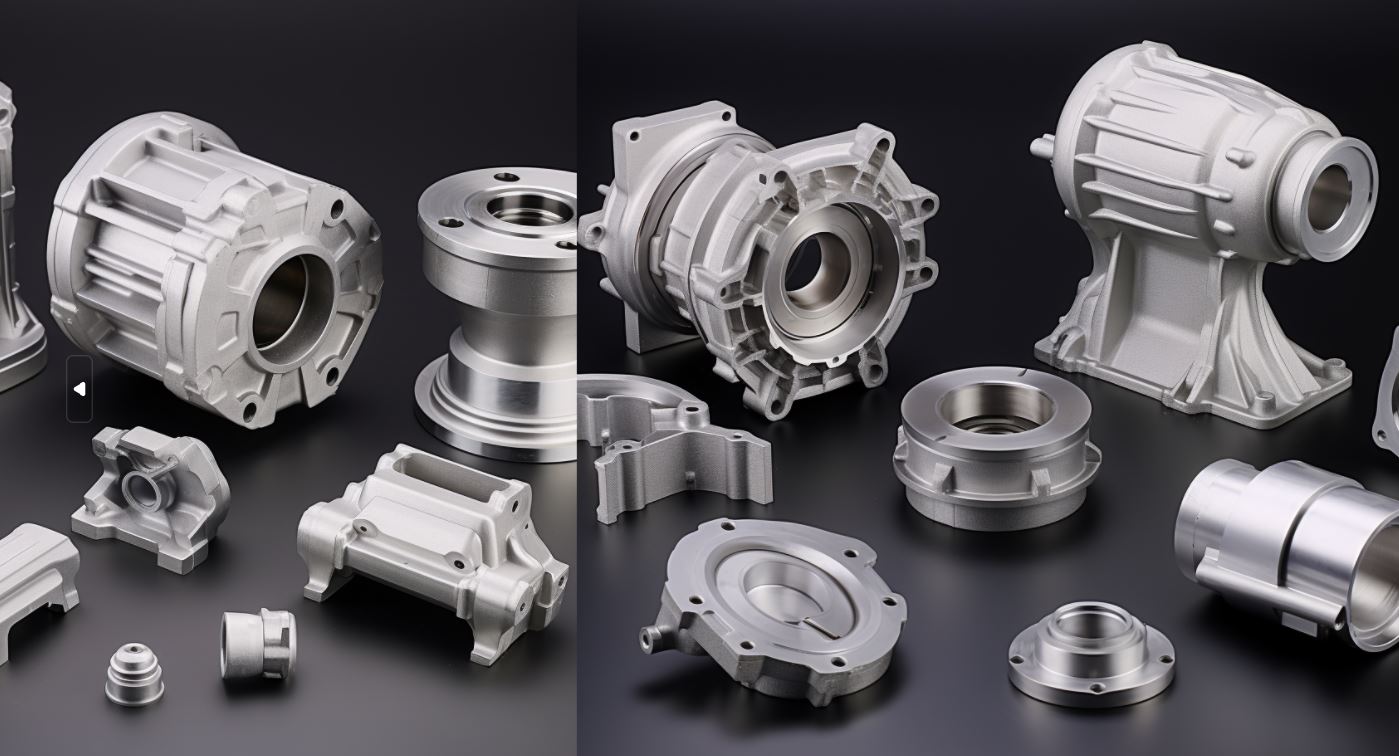
1. Shrinkage Porosity
Shrinkage porosity forms in the last regions of the casting to solidify — typically the thick sections or “hot spots” — where the liquid metal cannot reach before solidification is complete. The resulting cavities are irregular, rough and angular in shape. They weaken the section and can leak under pressure. Prevention is about feeding and heat control: size the risers to feed the heavy sections, place chills at hot spots to make them freeze earlier, keep wall thickness uniform, and design the casting so it solidifies directionally towards the riser. Simulation software is now routinely used to check feeding before the die is built.
2. Gas (Hydrogen) Porosity
Hydrogen is the only gas that dissolves appreciably in molten aluminium, and its solubility falls sharply when the metal solidifies. The rejected hydrogen forms rounded gas pores inside the casting. Gas porosity comes from moisture in the charge, damp fluxes, or hydrogen absorbed in melting. Prevention starts in the melt: degas with nitrogen or argon, keep the charge clean and dry, avoid excessive temperature and hold times, and pour calmly to prevent turbulence from drawing in air.
3. Hot Tearing
Hot tearing (also called hot cracking) happens during solidification while a thin liquid film still separates the dendrites. If the contracting casting cannot shrink freely, the film tears apart along the grain boundaries, leaving an irregular, jagged crack — usually at hot spots or where the section changes suddenly. It is one of the most frustrating defects because it appears intermittently. Prevention attacks both alloy and design: use alloys with better hot-tear resistance (higher silicon content helps), refine the grain, add fillets and radii at section changes, keep wall thickness uniform, provide enough feeding, use chills, and reduce restraint with collapsible sand cores. Controlling the die temperature and pouring temperature also matters.
4. Cold Cracking
Cold cracks form below the solidus, when the metal is fully solid. The part is fully solidified but still contracting; if it is constrained by the die or ejected too early, high residual stresses can produce a brittle crack. Unlike hot tears, cold cracks run through solidified metal. Prevention is largely about cooling and ejection: allow the casting to cool evenly, correct the die temperature distribution, eject at the right temperature, avoid sharp corners that concentrate stress, and use cooling fixtures to support the part as it cools.
5. Non-Fills, Cold Shuts and Misruns
These are filling defects where the molten metal freezes before it has completely filled the cavity. A cold shut is a visible seam where two streams of metal failed to fuse; a misrun is an incomplete section. They are triggered by a pour that is too cold, thin sections that chill the metal too fast, poor fluidity in the alloy, a die that is too cold, or an inadequate gating system. Prevention means controlling the pouring temperature, preheating the die to the right working temperature, designing gates that fill thin sections first, and choosing alloys with good fluidity.
6. Oxide and Non-Metallic Inclusions
Aluminium reacts instantly with oxygen, so oxide films and dross are always present on the surface of the melt. If these are dragged into the casting — through turbulent pouring, insufficient skimming or a dirty melt — they end up as non-metallic inclusions that weaken the part and ruin machined or anodised surfaces. Prevention is disciplined melt handling: skim and flux properly, degas, filter the metal at the point of pouring, pour quietly and steadily, and keep the melt free of dross build-up.
7. Segregation
Segregation is a local change in chemical composition across the casting, most often the “inverse segregation” where the last, eutectic-rich liquid is pushed towards the surface or into feeder regions. It causes non-uniform mechanical properties and inconsistent response to heat treatment. It is controlled by solidification conditions and, where needed, a homogenisation anneal (diffusion described by Fick’s law) after casting to even out the composition. Foundries that control cooling and mould coating tightly rarely suffer significant segregation.

Fundición a presión por gravedad
8. Iron Intermetallics
Iron is often present in secondary aluminium alloys, and it forms needle-shaped β-AlFeSi phases that are hard and brittle. They lower ductility, reduce fatigue life and promote shrinkage microporosity. Because iron is difficult to remove from the melt, prevention is metallurgical: specify low-iron alloys for demanding parts, add manganese to convert the brittle β phase into a less harmful α phase, and use faster cooling so the harmful needles stay small.
9. Surface and Die-Related Defects
Rough surfaces, soldering, sticking and flash are usually symptoms of die condition, not the alloy. If the die coating has worn, the working temperature is wrong, or the die surface has eroded, the casting skin suffers and parts stick. Prevention is disciplined tooling maintenance: reapply the refractory coating on schedule, control the die working temperature, inspect for erosion and washout, and use a proper release agent. A clean, well-maintained die is the cheapest insurance against surface defects.
10. Distortion and Dimensional Variation
Thin or asymmetric sections cool at different rates, and the resulting residual stress warps the part or moves it out of tolerance. Prevention is about even cooling: balance wall thickness, control the die temperature distribution, cool the part uniformly, extract it at the right temperature, and use cooling fixtures to hold shape while the casting settles. The earlier in the design process this is addressed, the fewer surprises appear in production.
The Cure: Directional Solidification, Risers and Chills
Underneath most of these defects is one idea: the casting should solidify from the thinnest section towards the thickest, and the riser — the last region to freeze — should feed the part until solidification is complete. This is directional solidification. Risers are sized by the modulus method: for non-ferrous castings the riser modulus is typically about 1.3 to 1.4 times the modulus of the section it feeds. Chills, usually copper or iron blocks placed in the die against heavy sections, accelerate local cooling so a hot spot freezes early instead of starving the metal.

Two shop-floor levers complete the picture: the working temperature of the die and the way it is coated. A die that is too cold promotes cold shuts and gas porosity, while a die that is too hot slows solidification and aggravates shrinkage. The refractory die coating is not decoration — it controls how quickly heat leaves the metal and releases the finished part. Foundries that treat die temperature and coating as process parameters, monitored on every shift, have consistently lower defect rates than those that leave them to chance.
| Herramienta | What it does | Defects it prevents |
| Risers | Hold liquid metal and feed the casting until it freezes | Shrinkage porosity, hot tearing |
| Chills | Accelerate local cooling at heavy sections | Shrinkage porosity, hot tearing |
| Sand cores | Form internal passages and allow contraction | Hot tearing, distortion |
| Die coating | Control heat extraction and release the part | Surface defects, sticking, cold shuts |
| Simulation (FEM) | Verify gating and riser design before tooling | All feeding and porosity defects |
Prevention Checklist
A foundry that consistently produces clean gravity castings usually follows a checklist like this one. If you are buying castings, these are exactly the questions worth asking.
| Defecto | Key prevention actions |
| Porosidad de contracción | Correct riser size; chills at hot spots; directional solidification; uniform wall thickness |
| Porosidad del gas | Degas (N2/Ar); dry, clean charge; controlled temperature; calm pouring |
| Hot tearing | Hot-tear-resistant alloy; grain refinement; radii at transitions; chills; collapsible cores; adequate feeding |
| Cold cracking | Even cooling; correct ejection temperature; cooling fixtures; avoid stress raisers |
| Non-fills / cold shuts | Correct pouring temperature; preheat the die; good gating; fluid alloy |
| Oxide inclusions | Skim and flux; filter; quiescent pouring; clean melt |
| Segregation | Controlled solidification; mould coating; homogenisation anneal if needed |
| Iron intermetallics | Low-iron alloy; manganese addition; faster cooling |
| Surface / die defects | Die coating on schedule; controlled die temperature; die inspection and maintenance |
| Distorsión | Balanced wall thickness; uniform die temperature; cooling fixtures |
Preguntas frecuentes
What is the most common defect in aluminium gravity die casting?
Shrinkage porosity is the most common and the most controllable. It is caused by insufficient feeding of the last regions to solidify and is prevented with correctly sized risers, chills and directional solidification.
Can gas porosity be removed from gravity castings?
Yes, mostly at the melt stage — degassing with nitrogen or argon removes hydrogen, and clean, dry handling prevents it returning. Castings can also be inspected by X-ray or pressure testing to confirm soundness.
Why do hot tears keep appearing even in a “good” die?
Hot tearing is strongly influenced by alloy composition, section geometry and restraint. A die that is otherwise fine can tear if the alloy has low hot-tear resistance, the section changes too abruptly, or a rigid core restricts contraction. Grain refinement, fillets, chills and collapsible cores are the usual fixes.
How can I check a supplier actually prevents defects?
Ask about their melt treatment (degassing, filtration), their die maintenance and coating schedule, whether they use risers and chills designed by the modulus method, and whether they run simulation or X-ray inspection. A supplier who can answer these in detail is far less likely to ship defective parts.
Does heat treatment fix casting defects?
Heat treatment can relieve stress and improve mechanical properties, but it cannot remove porosity, cracks or inclusions. Prevention at melting and solidification is the only real cure.
Conclusión
The defects that plague aluminium gravity die castings are neither mysterious nor unavoidable. Each one points back to a specific cause — usually a feeding problem, a melting problem, a mould condition, or a cooling issue — and each has a proven remedy. The best foundries combine careful melt treatment with sound riser and chill design, disciplined die maintenance, and simulation before the die is ever built. If you understand these ten defects and how they are prevented, you will be able to buy castings with far more confidence — and hold your suppliers to a higher standard.

0 Comentarios