
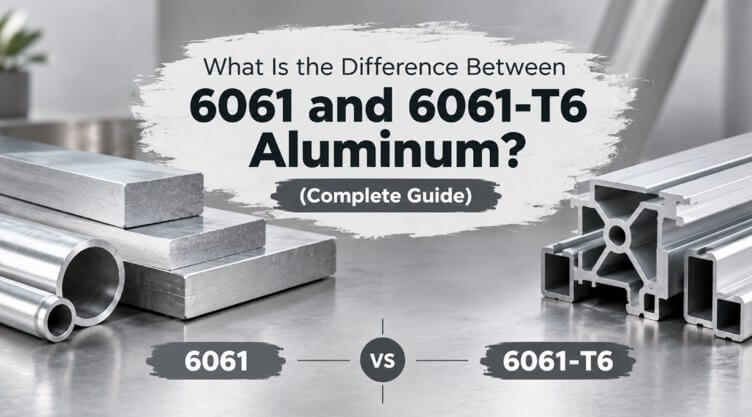
알루미늄을 주문해 본 적이 있다면, 6061 알루미늄과 6061-T6이 거의 같은 의미로 사용되는 것을 눈치챘을 것입니다. 많은 사람들이 이 두 가지가 서로 다른 금속이라고 당연시합니다. 하지만 그렇지 않습니다.
간단히 말해, 6061 알루미늄은 합금이며, T6는 템퍼(temper)로, 합금이 어떻게 열처리되었는지를 나타내는 코드입니다. 숫자 “6061”은 화학 성분을 나타냅니다. “T6”라는 숫자는 합금의 상태에 대한 정보를 제공하며, 결과적으로 강도, 경도 및 거동 특성에 대한 정보를 알려줍니다.
실제 프로젝트에서는 이 점이 중요합니다. 열처리 등급이 명시되지 않은 “6061”이라는 명칭은, 부드럽고 구부리기 쉬운 어닐링 처리된 소재부터 단단하고 강도가 높은 T6 판재에 이르기까지 서로 다른 결과를 초래할 수 있습니다. 이 가이드에서는 6061 알루미늄 소재의 구성, T6 표기가 의미하는 바, 6061과 다양한 다른 템퍼 간의 비교, 그리고 올바른 6061 템퍼를 선택하는 방법을 명확히 설명합니다.
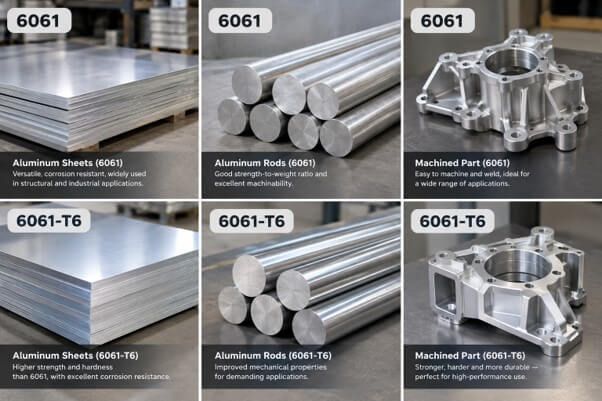
6061 알루미늄이란 무엇인가요?
6061 알루미늄은 가장 널리 사용되는 소재 중 하나입니다. 알루미늄 합금 세계에서. 이 합금은 6xxx 계열에 속하며, 주요 합금 원소는 마그네슘과 실리콘입니다. 이 두 원소는 마그네슘 실리사이드(Mg₂Si)를 형성함으로써 합금의 열처리성을 부여합니다.
6061의 일반적인 화학 성분
| 요소 | 대표적인 내용 (%) |
| 알루미늄(Al) | 균형 (약 95.8~98.6) |
| 마그네슘(Mg) | 0.8-1.2 |
| 실리콘(Si) | 0.4-0.8 |
| 철(Fe) | 최대 0.7 |
| 구리(Cu) | 0.15-0.40 |
| 크롬(Cr) | 0.04-0.35 |
| 아연(Zn) | 최대 0.25 |
| 망간(Mn) | 최대 0.15 |
| 티타늄(Ti) | 최대 0.15 |
6061이 왜 인기가 있을까요?
6061 알루미늄은 자전거 프레임, 항공기 부품, 트럭 프레임, 선박용 부속품, 구조용 부품, 카메라 본체, 압력 용기 등(이것들은 일부 예에 불과합니다)은 물론, 수많은 기계 가공 부품에 사용됩니다. 6061이 널리 알려진 이유는 다음과 같습니다.;
- 범용 합금치고는 뛰어난 강중량비.
- 대부분의 대기 및 해양 환경에서 뛰어난 내식성을 발휘합니다.
- 일반적인 용접 기법(TIG 및 MIG)을 사용했을 때 뛰어난 용접성
- 경도가 높은 상태에서 뛰어난 가공성을 나타냅니다.
- 양극 산화 처리에 강하며, 깔끔하고 균일한 외관을 유지합니다.
- 시트, 판재, 봉재, 튜브, 압출재 및 단조품 형태로 적절하게 성형되어 있으며, 시중에서 널리 구할 수 있습니다.
- 7075과 같은 고강도 합금에 비해 비용이 적당한 편입니다.
6061-T6에서 “T6”은 무엇을 의미하나요?
알루미늄 합금은 4자리 합금 번호를 가지며, 그 뒤에 템퍼 명칭이 붙습니다. ‘템퍼(temper)’라는 용어는 금속에 적용된 기계적 또는 열적 처리를 의미합니다. 6061과 같은 열처리 가능한 합금의 경우, 템퍼 표기법에는 문자 ‘T’ 뒤에 숫자가 붙으며, 이는 적용된 열처리 공정을 나타냅니다. 이는 기본적으로 용체화 열처리를 거친 후 인위적으로 노화시킨 상태를 의미합니다.
T6 템퍼를 만드는 방법은 무엇인가요?
T6 템퍼를 제조하는 데 사용할 수 있는 몇 가지 방법은 다음과 같습니다.;
- 솔루션 열처리: 합금을 약 530°C(약 985°F)까지 가열하면, 알루미늄에 포함된 마그네슘과 실리콘이 용해되어 균일한 고체 용액을 형성한다.
- 담금질: 이 금속은 물에 담가 급속 냉각(담금질)을 거쳤으며, 이로 인해 해당 원소들이 용액 상태에 유지되었습니다.
- 인공 노화(침전 경화): 금속을 적당한 온도(보통 160~175°C 또는 320~350°F)에서 몇 시간 동안 가열합니다. 이 단계에서 금속 내부에 미세한 Mg₂Si 입자가 침전되는데, 이 입자들은 금속 내의 전위가 자유롭게 이동하는 것을 막아 결과적으로 금속 합금의 강도와 경도를 크게 향상시킵니다.
그 결과, 연화 상태의 동일한 합금에 비해 항복 강도와 경도가 상당히 높은 소재가 만들어집니다.
흔한 T6 변이: T651 및 T6511
공급업체 목록에서도 동일한 접미사를 확인할 수 있습니다:
| 명칭 | 의미 |
| T6 | 용액 열처리 및 인위적 노화 처리 |
| T651 | T6 처리 후, 인발 가공을 통해 응력 제거 (판재 및 압연 제품) |
| T6511 | T6 처리 후, 약간의 곧게 펴기를 허용한 상태에서 인발하여 응력 제거 (압출 제품) |
응력을 제거함으로써 내부 응력이 낮아져 가공 중 뒤틀림의 위험을 줄일 수 있습니다. 6061-T651은 일반적으로 정밀 판재 가공에 선호되는 소재입니다.
6061 대 6061-T6 알루미늄: 핵심적인 차이점
간단히 말해서:
- 이 합금은 6061입니다(합금의 화학 성분).
- T6는 합금의 상태를 나타내는 명칭으로, 이 경우 열처리를 거친 6061을 의미합니다.
비유하자면, “강철”은 재료를 의미하고, “경화강”은 동일한 재료가 특정 상태에 놓인 것을 의미합니다. 마찬가지로, 숫자 6061은 합금을 나타내고, 문자 T는 해당 합금에 수행된 경화 및 노화 처리를 나타냅니다.
그러니 혹시 누군가 “~와 ~의 차이점은 무엇인가요?”라고 묻는다면, 6061-T6 대 6061 알루미늄 ”다른 템퍼에서는 어떨까요?“ 실제 질문은 “6061-T6 알루미늄이 다른 템퍼의 6061과 정확히 어떻게 다른가요?”입니다.
6061과 6061-T6 알루미늄의 간략한 비교표
| 기능 | 6061 (Alloy Name Only) | 6061-T6 aluminum |
| What it describes | The alloy composition | Alloy plus a specific heat treatment |
| 힘 | Not defined (depends on temper) | High (yield about 275 MPa) |
| 경도 | Not defined | About 95 Brinell |
| Heat treatment specified? | 아니요 | Yes (solution treated and artificially aged) |
| Suitable for ordering? | Ambiguous, so always add a temper | Yes, a complete specification |
| Typical form | Could be O, T4, T6, F or other | Sheet, plate, bar, tube, extrusion |
The Temper Matters: 6061 in Different Conditions
6061 is not a specification for strength, so here is some of its strength in the most common tempers.
Common Tempers of 6061 Aluminum
| Temper | 설명 | Typical Condition |
| 6061-O | Annealed | Softest, most ductile |
| 6061-F | As fabricated | No controlled temper, properties vary |
| 6061-T4 | Solution heat treated and naturally aged | Moderate strength, good formability |
| 6061-T6 | Solution heat treated and artificially aged | High strength, the most common |
| 6061-T651 | T6 with stress relief by stretching | High strength, low residual stress |
Two things that stand out. First of all, the yield strength of T6 is about five times that of the annealed 6061-O. Second, density and stiffness do not change with temper: a T6 part weighs the same as an O-temper part and is no stiffer. An increase in strength and hardness does not occur with an increase in elastic modulus through heat treatment.
Detailed Differences: 6061 (Other Tempers) vs 6061-T6
1. Strength and Hardness
This is the most significant distinction. 6061-T6 aluminum is among the strongest grades of 6061 temper. It has a yield strength of about 275 MPa. Annealed 6061-O is soft enough to bend and hand-form into shape in thinner gauges, whereas T6 temper is stiff and difficult to dent and deform.
If you have to work under load on a part, you should choose temper T6.
2. Formability and Bending
As a consequence of the strength increase, formability decreases. Bending of 6061-T6 to a small radius can result in cracking, especially on the bend line.
Forming properties of 6061
- 6061-O: High formability; suitable for deep drawing and tight bending
- 6061-T4: Good formability; can be formed and then aged to T6 strength
- 6061-T6: Poor formability; should be bent with large radii
Use a common way, i.e. is to form the component in temper O or T4. Then age it to temper T6 afterwards easily. It should be noted that the parts may distort in the course of quenching.
3. Machinability
The T6 version of 6061-T6 is more easily machinable than the other tempers. When in the O temper, aluminum becomes gummy, gets stuck to cutting tools, and has poor surface finish. The T6 temper machines cleanly and creates better chips with tighter tolerances.
When it comes to CNC machining, the two most popular alloys are 6061-T6 and 6061-T651. The latter is chosen for machining large plates and thin plates due to the reduced residual stress, which prevents warping during material removal.
4. 용접성
6061 is recognized as a weldable material, but the welding process changes the temper. Heat applied during welding softens the metal and creates a heat-affected zone (HAZ) of low strength, close to that of annealed material.
| Welding Consideration | Effect on 6061-T6 |
| Heat-affected zone | Local loss of strength near the weld |
| Filler alloy | Commonly 4043 or 5356, depending on the application |
| Post-weld heat treatment | Can restore much of the strength if the part can be re-solution treated and aged |
| Design implication | Account for reduced strength at weld locations |
If a welded structure must keep T6 strength, either design with the weakened zone in mind or plan a full post-weld heat treatment (which is not practical for large assemblies).
5. 내식성
Corrosion resistance is high in all tempers with minimal variations. 6061 alloy forms a protective oxide film and has good performance in air, fresh water, and most sea environments. 6061 alloy has greater corrosion resistance compared to copper-based alloys like 2024 and 7075.
6. Anodizing and Surface Finish
Both 6061-O and 6061-T6 are good for anodizing and provide an aesthetic finish that comes in many colors. Higher tempers give better machining finish before anodization.
7. Thermal and Electrical Conductivity
Heating reduces electrical and thermal conductivity from the values for the annealed metal. It is mainly due to scattering by dissolved and precipitated elements.
| 속성 | 6061-O | 6061-T6 |
| 열 전도성 | ~180 W/m·K | ~167 W/m·K |
| 전기 전도성 | ~47% IACS | ~43% IACS |
They both make excellent conductors, which is the reason why alloy 6061 is utilized for heat sinks and electronic hardware applications.
8. Cost and Availability
6061-T6 and 6061-T651 are the most popular temper types and most available in inventory, thus making them easy to purchase at competitive prices. Other temper types such as O or T4 will have to be specially ordered based on the product type.
Why Does “6061” Often Mean “6061-T6”?
When talking about this alloy, “6061” is usually a reference to the temper 6061-T6 or 6061-T651, as that is the one most buyers are looking for, and most suppliers carry. This is a habit, not a standard.
A part listing with “6061 aluminum bar” might still match T6, but it’s always best to double-check. If strength or formation requirements are critical, use “Temper” designation explicitly, e.g., “6061-T6511 extruded bar” or “6061-T651 plate.
How Heat Treatment Changes 6061: A Simple Explanation
Imagine that the microstructure of the alloys is a stuffy room.
- The annealed (O) state has large, coarse particles, distributed randomly in a non-uniform pattern, and layers of atoms slide past one another easily. The metal is soft.
- For T6, elements are dissolved by heat treatment and subsequently re-precipitated in very small, uniformly distributed particles. These act like obstacles that make it hard for atomic layers to slip. The metal becomes strong and hard.
This is why it is sometimes said that T6 is precipitation-hardened or age-hardened.
When to Choose 6061-T6 vs Other Tempers
Here are some ways you can decide on the right option;
Choose 6061-T6 (or T651) when:
- High strength and hardness are required in a structural/load carrying component.
- The part will be CNC manufactured and, in particular, will be a flat plate (T651).
- Good fatigue performance and dimensional stability are required.
- The part will not be bent sharply after purchase
- The most common, most available, cost-effective option is what you want.
Choose 6061-T4 or 6061-O when:
- The part needs to be bent, rolled, or formed substantially
- You intend to undertake heat treatment post-forming to achieve T6 strength
- The cycle of forming requires maximum ductility and crack resistance.
- The completed component will have limited weight capacity
How to Specify 6061 Correctly When Ordering
Include the following in purchase orders and drawings to prevent receiving the wrong material:
- Alloy: 6061
- Temper: T6, T651, T6511, T4 or O
- Master Alloy of Copper: Product form: Plate, sheet, bar, tube, extrusion, or forging
- Dimensions and tolerances
- Available standard:g., ASTM B209 (sheet and plate), ASTM B221 (extrusions), or AMS specifications for aerospace
- Mill Test Certificate(s): Ensure a mill test certificate is available to verify composition and mechanical properties.
자주 묻는 질문(FAQ)
Is 6061 the same as 6061-T6?
That is alloy 6061; aluminum 6061-T6 is that alloy solution heat-treated and artificially aged. Every piece of 6061-T6 is 6061, but not every piece of 6061 is T6.
What does T6 mean in aluminum?
T6 is a solution heat-treating, quenching, and artificial aging process that makes the metal stronger and harder.
Is 6061-T6 stronger than 6061?
Yes, by a long way when compared to annealed 6061-O. They are, of course, stronger than other tempers like T4. The “6061” designation does not give the strength; it is only a designation for the alloy alone.
Why is there a difference between 6061-T4 and 6061-T6?
T4 is solution heat-treated and naturally aged at room temperature, with moderate strength and better formability. T6 is artificially aged for increased strength and hardness with reduced ductility.
Is it OK to heat treat 6061 myself?
Absolutely, but only when you have ideal conditions for temperature control, quench speed, and aging time. Errors cause distortion, cracking, or lower-than-expected properties. Please go to a qualified heat treatment provider for critical parts.
Can 6061-T6 be welded?
Yes, but the strength of the weld area is reduced. Plan for the reduced properties in the heat-affected zone, or consider post-weld heat treatment where feasible.
Can 6061-T6 be CNC Machined?
Of course it is one of the alloys most used for CNC machining for that very reason; it cuts well, and it keeps tolerances and looks good. For plates, T651 is the most preferred because less warping occurs.
Is 6061-T6 rustproof?
As opposed to steel, aluminium does not rust. It has a fine layer of an oxide film and shows good corrosion resistance, although it may be corroded under certain conditions. Coatings (such as anodizing) provide additional protection.
Why is 6061-T6 so common?
It has an unusual combination of strength, corrosion resistance, weldability, machinability, and affordability, and is offered in almost every product form.

결론
The difference between 6061 material and 6061-T6 condition is a material versus a condition. The alloy of aluminium, magnesium, and silicon is known as 6061. Alloy T6 is FEATURED for high strength/hardness, as it has been solution heat-treated and artificially aged.
The key points to remember:
- 6061 is the alloy; T6 is the temper.
- T6 increases yield strength to approximately five times that of 6061-O, but the material retains the original density and stiffness.
- T6 has high strength, high corrosion resistance, and outstanding mechanical machining properties, which are not ideal for close bending.
- You need to design for the fact that the metal will be softened around the weld.
- When ordering, always identify the complete specification (e.g., 6061-T651), as various materials may have the designation 6061.
The selection of the proper temper for the use ensures satisfactory performance without high cost or issues in the field.
0개의 댓글