
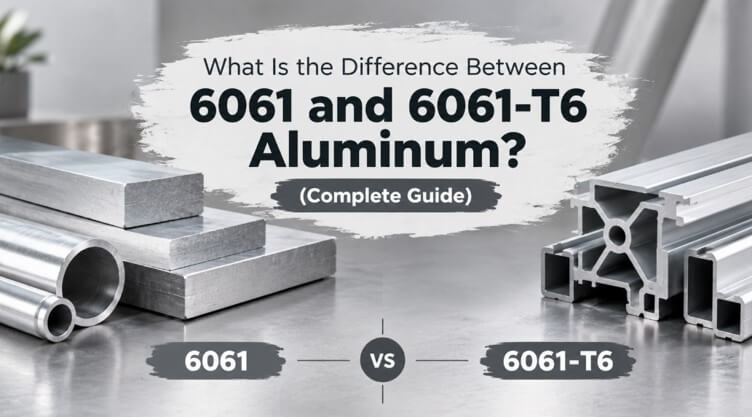
If you’ve ever ordered aluminum, you’ve probably noticed that 6061 aluminum is used nearly interchangeably with 6061-T6. Numerous people take it for granted that they’re two distinct metals. They are not.
The short answer is that 6061 aluminum is the alloy, and T6 is a temper, a code used to describe how the alloy has been heat-treated. The number “6061” indicates the chemical composition. The number “T6” provides you with information on its condition and, as a result, its strength, hardness, and behavior.
In real projects, it does matter. The “6061” designation without a temp designation can have different results, like soft, easy-to-bend annealed stock or hard, strong T6 plate. This guide clarifies the material component 6061 aluminum, what the T6 designation indicates, the comparison of 6061 to various other tempers, and how to choose the correct 6061 temper.
What Is 6061 Aluminum?
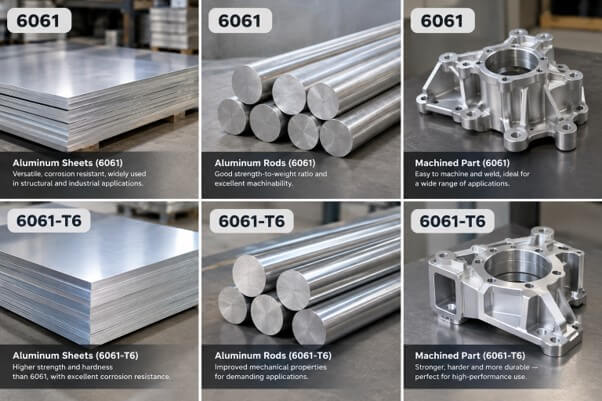
6061 aluminum is one of the most popular アルミニウム合金 in the world. It belongs to the 6xxx series, whose main alloying elements are magnesium and silicon. These two elements create the alloy’s heat-treatability by forming magnesium silicide (Mg₂Si).
Typical Chemical Composition of 6061
| エレメント | Typical Content (%) |
| アルミニウム(Al) | Balance (about 95.8-98.6) |
| マグネシウム (Mg) | 0.8-1.2 |
| ケイ素 (Si) | 0.4-0.8 |
| 鉄(Fe) | Up to 0.7 |
| 銅(Cu) | 0.15-0.40 |
| クロム(Cr) | 0.04-0.35 |
| 亜鉛 | Up to 0.25 |
| マンガン (Mn) | Up to 0.15 |
| チタン(Ti) | Up to 0.15 |
Why is 6061 popular?
The 6061 aluminum is used in bicycle frames, aircraft parts, truck frames, marine fittings, structural parts, camera bodies, and pressure vessels, to mention just a few, and in a vast number of machined parts. Here are some reasons why 6061 is famous;
- Great strength-to-weight ratio for a general-purpose alloy.
- It offers excellent corrosion properties in most atmospheric and marine environments.
- Excellent weldability with common techniques (TIG and MIG)
- Excellent machinability in tougher tempers.
- Resists anodizing with a clean, even appearance
- Properly shaped in sheet, plate, bar, tube, extrusions, and forgings; widely available
- Moderate cost when compared to high-strength alloys like 7075
What Does “T6” Mean in 6061-T6?
Aluminum alloys have a four-digit alloy number and are followed by a temper designation. The word temper refers to the mechanical or thermal treatment the metal was given. The tempers use the letter T followed by a number for heat-treatable alloys such as 6061 that would indicate the heat treatment process applied. It is basically a solution-heat-treated and artificially aged condition.
How to Produce T6 Temper?
Here are some ways we can use to produce T6 Temper;
- 溶液熱処理: The alloy is heated to approximately 530°C (about 985°F), dissolving the magnesium and silicon in the aluminum to make a uniform solid solution.
- 焼き入れ: The metal has been quenched, or suddenly cooled, most recently in water, keeping those elements in solution.
- Artificial aging (precipitation hardening): The metal is heated at a moderate temperature (usually 160-175°C or 320-350°F) for several hours. In this step, we get the precipitation of fine Mg₂Si particles in the metal, which prevent the dislocations from moving freely in the metal and consequently increase the strength and hardness of the metal alloy tremendously.
The result is a material that has substantially greater yield strength and hardness than the same alloy in the soft, unaged condition.
Common T6 Variants: T651 and T6511
The same suffixes can be found on supplier listings:
| Designation | Meaning |
| T6 | Solution heat-treated and artificially aged |
| T651 | T6, then stress-relieved by stretching (plate and rolled products) |
| T6511 | T6, then stress-relieved by stretching with minor straightening allowed (extruded products) |
By relieving the stresses, the internal stresses are lowered to reduce the risk of warping during machining. 6061-T651 is generally preferred for precision plate machining.
6061 vs 6061-T6 Aluminum: The Core Difference
Put simply:
- The alloy is 6061 (the chemistry of the alloy).
- The T6 is a designation that represents the alloy condition, in this case, heat-treated 6061.
Analogy: “steel” denotes a material; “hardened steel” denotes that same material in a certain condition. Likewise, the number 6061 represents the alloy, and the letter T represents a hardening and ageing performed on the alloy.
So, if anyone asks, “What is the difference between 6061-T6 vs 6061 aluminum in the other tempers?” The actual question is, “How exactly is 6061-T6 aluminum different than 6061 in other tempers?
Quick Comparison Table between 6061 and 6061-T6 aluminum
| 特徴 | 6061 (Alloy Name Only) | 6061-T6 aluminum |
| What it describes | The alloy composition | Alloy plus a specific heat treatment |
| 強さ | Not defined (depends on temper) | High (yield about 275 MPa) |
| 硬度 | Not defined | About 95 Brinell |
| Heat treatment specified? | いいえ | Yes (solution treated and artificially aged) |
| Suitable for ordering? | Ambiguous, so always add a temper | Yes, a complete specification |
| Typical form | Could be O, T4, T6, F or other | Sheet, plate, bar, tube, extrusion |
The Temper Matters: 6061 in Different Conditions
6061 is not a specification for strength, so here is some of its strength in the most common tempers.
Common Tempers of 6061 Aluminum
| Temper | 説明 | Typical Condition |
| 6061-O | Annealed | Softest, most ductile |
| 6061-F | As fabricated | No controlled temper, properties vary |
| 6061-T4 | Solution heat treated and naturally aged | Moderate strength, good formability |
| 6061-T6 | Solution heat treated and artificially aged | High strength, the most common |
| 6061-T651 | T6 with stress relief by stretching | High strength, low residual stress |
Two things that stand out. First of all, the yield strength of T6 is about five times that of the annealed 6061-O. Second, density and stiffness do not change with temper: a T6 part weighs the same as an O-temper part and is no stiffer. An increase in strength and hardness does not occur with an increase in elastic modulus through heat treatment.
Detailed Differences: 6061 (Other Tempers) vs 6061-T6
1. Strength and Hardness
This is the most significant distinction. 6061-T6 aluminum is among the strongest grades of 6061 temper. It has a yield strength of about 275 MPa. Annealed 6061-O is soft enough to bend and hand-form into shape in thinner gauges, whereas T6 temper is stiff and difficult to dent and deform.
If you have to work under load on a part, you should choose temper T6.
2. Formability and Bending
As a consequence of the strength increase, formability decreases. Bending of 6061-T6 to a small radius can result in cracking, especially on the bend line.
Forming properties of 6061
- 6061-O: High formability; suitable for deep drawing and tight bending
- 6061-T4: Good formability; can be formed and then aged to T6 strength
- 6061-T6: Poor formability; should be bent with large radii
Use a common way, i.e. is to form the component in temper O or T4. Then age it to temper T6 afterwards easily. It should be noted that the parts may distort in the course of quenching.
3. Machinability
The T6 version of 6061-T6 is more easily machinable than the other tempers. When in the O temper, aluminum becomes gummy, gets stuck to cutting tools, and has poor surface finish. The T6 temper machines cleanly and creates better chips with tighter tolerances.
When it comes to CNC machining, the two most popular alloys are 6061-T6 and 6061-T651. The latter is chosen for machining large plates and thin plates due to the reduced residual stress, which prevents warping during material removal.
4.溶接性
6061 is recognized as a weldable material, but the welding process changes the temper. Heat applied during welding softens the metal and creates a heat-affected zone (HAZ) of low strength, close to that of annealed material.
| Welding Consideration | Effect on 6061-T6 |
| Heat-affected zone | Local loss of strength near the weld |
| Filler alloy | Commonly 4043 or 5356, depending on the application |
| Post-weld heat treatment | Can restore much of the strength if the part can be re-solution treated and aged |
| Design implication | Account for reduced strength at weld locations |
If a welded structure must keep T6 strength, either design with the weakened zone in mind or plan a full post-weld heat treatment (which is not practical for large assemblies).
5.耐食性
Corrosion resistance is high in all tempers with minimal variations. 6061 alloy forms a protective oxide film and has good performance in air, fresh water, and most sea environments. 6061 alloy has greater corrosion resistance compared to copper-based alloys like 2024 and 7075.
6. Anodizing and Surface Finish
Both 6061-O and 6061-T6 are good for anodizing and provide an aesthetic finish that comes in many colors. Higher tempers give better machining finish before anodization.
7. Thermal and Electrical Conductivity
Heating reduces electrical and thermal conductivity from the values for the annealed metal. It is mainly due to scattering by dissolved and precipitated elements.
| プロパティ | 6061-O | 6061-T6 |
| 熱伝導率 | ~180 W/m·K | ~167 W/m·K |
| 電気伝導度 | ~47% IACS | ~43% IACS |
They both make excellent conductors, which is the reason why alloy 6061 is utilized for heat sinks and electronic hardware applications.
8. Cost and Availability
6061-T6 and 6061-T651 are the most popular temper types and most available in inventory, thus making them easy to purchase at competitive prices. Other temper types such as O or T4 will have to be specially ordered based on the product type.
Why Does “6061” Often Mean “6061-T6”?
When talking about this alloy, “6061” is usually a reference to the temper 6061-T6 or 6061-T651, as that is the one most buyers are looking for, and most suppliers carry. This is a habit, not a standard.
A part listing with “6061 aluminum bar” might still match T6, but it’s always best to double-check. If strength or formation requirements are critical, use “Temper” designation explicitly, e.g., “6061-T6511 extruded bar” or “6061-T651 plate.
How Heat Treatment Changes 6061: A Simple Explanation
Imagine that the microstructure of the alloys is a stuffy room.
- The annealed (O) state has large, coarse particles, distributed randomly in a non-uniform pattern, and layers of atoms slide past one another easily. The metal is soft.
- For T6, elements are dissolved by heat treatment and subsequently re-precipitated in very small, uniformly distributed particles. These act like obstacles that make it hard for atomic layers to slip. The metal becomes strong and hard.
This is why it is sometimes said that T6 is precipitation-hardened or age-hardened.
When to Choose 6061-T6 vs Other Tempers
Here are some ways you can decide on the right option;
Choose 6061-T6 (or T651) when:
- High strength and hardness are required in a structural/load carrying component.
- The part will be CNC manufactured and, in particular, will be a flat plate (T651).
- Good fatigue performance and dimensional stability are required.
- The part will not be bent sharply after purchase
- The most common, most available, cost-effective option is what you want.
Choose 6061-T4 or 6061-O when:
- The part needs to be bent, rolled, or formed substantially
- You intend to undertake heat treatment post-forming to achieve T6 strength
- The cycle of forming requires maximum ductility and crack resistance.
- The completed component will have limited weight capacity
How to Specify 6061 Correctly When Ordering
Include the following in purchase orders and drawings to prevent receiving the wrong material:
- Alloy: 6061
- Temper: T6, T651, T6511, T4 or O
- Master Alloy of Copper: Product form: Plate, sheet, bar, tube, extrusion, or forging
- Dimensions and tolerances
- Available standard:g., ASTM B209 (sheet and plate), ASTM B221 (extrusions), or AMS specifications for aerospace
- Mill Test Certificate(s): Ensure a mill test certificate is available to verify composition and mechanical properties.
よくある質問 (FAQ)
Is 6061 the same as 6061-T6?
That is alloy 6061; aluminum 6061-T6 is that alloy solution heat-treated and artificially aged. Every piece of 6061-T6 is 6061, but not every piece of 6061 is T6.
What does T6 mean in aluminum?
T6 is a solution heat-treating, quenching, and artificial aging process that makes the metal stronger and harder.
Is 6061-T6 stronger than 6061?
Yes, by a long way when compared to annealed 6061-O. They are, of course, stronger than other tempers like T4. The “6061” designation does not give the strength; it is only a designation for the alloy alone.
Why is there a difference between 6061-T4 and 6061-T6?
T4 is solution heat-treated and naturally aged at room temperature, with moderate strength and better formability. T6 is artificially aged for increased strength and hardness with reduced ductility.
Is it OK to heat treat 6061 myself?
Absolutely, but only when you have ideal conditions for temperature control, quench speed, and aging time. Errors cause distortion, cracking, or lower-than-expected properties. Please go to a qualified heat treatment provider for critical parts.
Can 6061-T6 be welded?
Yes, but the strength of the weld area is reduced. Plan for the reduced properties in the heat-affected zone, or consider post-weld heat treatment where feasible.
Can 6061-T6 be CNC Machined?
Of course it is one of the alloys most used for CNC machining for that very reason; it cuts well, and it keeps tolerances and looks good. For plates, T651 is the most preferred because less warping occurs.
Is 6061-T6 rustproof?
As opposed to steel, aluminium does not rust. It has a fine layer of an oxide film and shows good corrosion resistance, although it may be corroded under certain conditions. Coatings (such as anodizing) provide additional protection.
Why is 6061-T6 so common?
It has an unusual combination of strength, corrosion resistance, weldability, machinability, and affordability, and is offered in almost every product form.

結論
The difference between 6061 material and 6061-T6 condition is a material versus a condition. The alloy of aluminium, magnesium, and silicon is known as 6061. Alloy T6 is FEATURED for high strength/hardness, as it has been solution heat-treated and artificially aged.
The key points to remember:
- 6061 is the alloy; T6 is the temper.
- T6 increases yield strength to approximately five times that of 6061-O, but the material retains the original density and stiffness.
- T6 has high strength, high corrosion resistance, and outstanding mechanical machining properties, which are not ideal for close bending.
- You need to design for the fact that the metal will be softened around the weld.
- When ordering, always identify the complete specification (e.g., 6061-T651), as various materials may have the designation 6061.
The selection of the proper temper for the use ensures satisfactory performance without high cost or issues in the field.
0コメント