
El aluminio es uno de los metales más utilizados en la producción actual. Es ligero, resistente a la corrosión, reciclable y tiene un precio asequible. Por ello, se utiliza en todo tipo de aplicaciones, desde teléfonos móviles hasta trenes de aterrizaje de aviones. Sin embargo, no todas las piezas de aluminio son iguales.
Fundición a presión de aluminio y la forja son los dos procesos de fabricación más habituales. Ambos procesos permiten obtener piezas metálicas de buena calidad, pero existen diferencias significativas en cuanto al proceso, la estructura interna, la resistencia, el coste y la aplicación ideal de cada uno.
Si eres ingeniero, comprador, diseñador de productos o aficionado y tienes que elegir entre aluminio fundido a presión y aluminio forjado, esta guía te explica cómo funciona cada proceso, en qué se diferencian ambos materiales y cuál es el más adecuado para tu proyecto.
¿Qué es el aluminio fundido a presión?
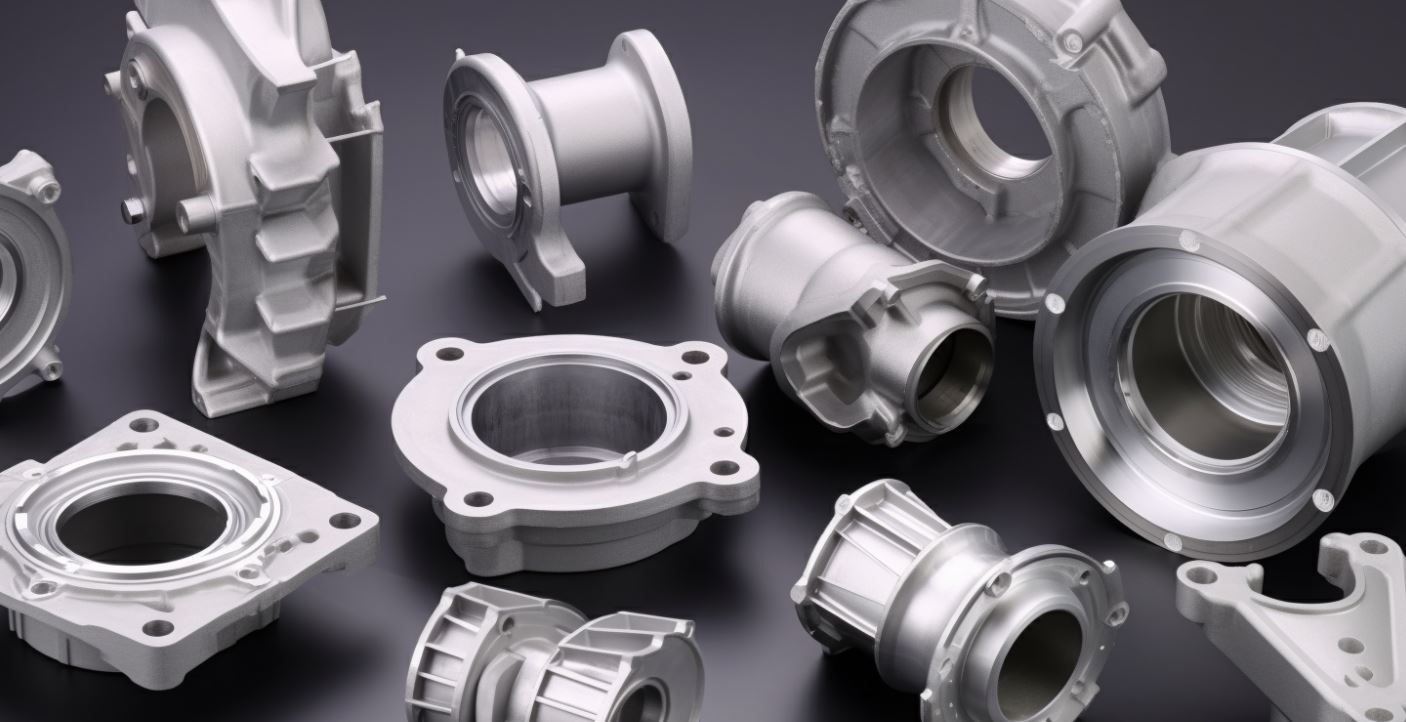
Fundición a presión de aluminio se inyecta a presión en un molde de acero, conocido como «matriz», que puede reutilizarse. El metal rellena todos los detalles de la cavidad, se enfría, se solidifica y, a continuación, se expulsa la pieza final.
También se conoce como proceso de fundición a presión de aluminio y fundición a presión de alta presión (HPDC). Se trata de un proceso de fundición, lo que significa que el metal pasa por un estado líquido antes de adoptar su forma definitiva.
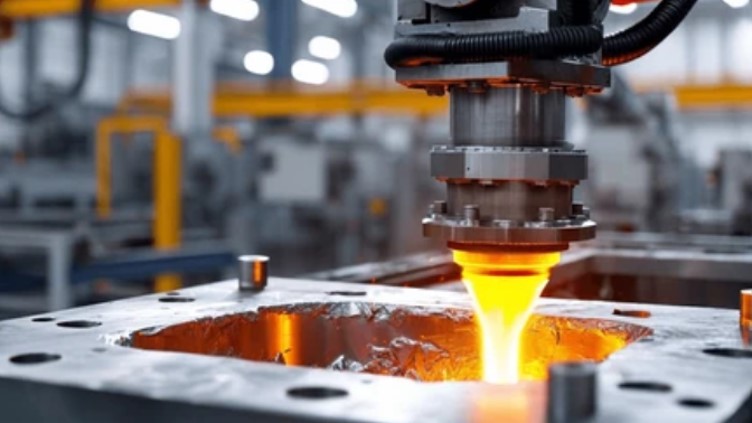
Cómo funciona el proceso de fundición a presión de aluminio
Limpia y aplica una capa previa de lubricante a las dos mitades de los troqueles de acero endurecido para controlar la temperatura y facilitar la separación de las piezas.
- Fundición: Este proceso suele realizarse en un horno a una temperatura de entre 650 y 720 °C.
- Inyección: El metal fundido, a alta velocidad y alta presión, se inyecta en la cavidad del molde.
- Enfriamiento y solidificación: El metal se enfría rápidamente en el molde, tras lo cual se solidifica adoptando la forma deseada.
- Expulsión: A continuación, la pieza moldeada es expulsada por un conjunto de pasadores de expulsión.
- Recorte y acabado: Se elimina el material sobrante (rebabas, entradas y canales de colada). A continuación, la pieza puede someterse a tratamientos y procesos adicionales, como mecanizado, pulido, recubrimiento en polvo o anodizado.
Aleaciones de aluminio habituales para la fundición a presión
La elección de la aleación se basa en la resistencia mecánica, la resistencia a la corrosión, la fluidez y el coste. En la siguiente tabla se comparan las cuatro aleaciones de aluminio más utilizadas para la fundición a presión.
| Aleación (equivalente) | Elementos clave | Resistencia a la tracción | Límite elástico | Alargamiento | Densidad | Resistencia a la corrosión | Lo mejor para |
| A380 (ADC10) | Si 7,5-9,5 %, Cu 3-4 % | ~324 MPa | ~160 MPa | ~3.5% | ~2,74 g/cm³ | Feria | Piezas de uso general, carcasas, soportes |
| A383 (ADC12) | Si 9,5-11,5 %, Cu 2-3 % | ~310 MPa | ~150 MPa | ~3.5% | ~2,74 g/cm³ | Feria | Piezas complejas de paredes delgadas |
| A360 | Si 9-10 %, Mg 0,4-0,6 % | ~317 MPa | ~170 MPa | ~3.5% | ~2,63 g/cm³ | Excelente | Piezas propensas a la corrosión y a altas temperaturas |
| A413 | Entre el 11 % y el 13 % | ~296 MPa | ~130 MPa | ~3.5% | ~2,66 g/cm³ | Excelente | Componentes hidráulicos y neumáticos a prueba de presión |
Ventajas del aluminio fundido a presión
Las siguientes características te ayudan a comprender las ventajas del aluminio fundido a presión
- Son adecuadas para formas complejas y detalles precisos
- Hay muchos diseños que permiten conseguir paredes finas (de aproximadamente 1 mm o menos).
- Alta velocidad de producción y alta repetibilidad.
- Reducción efectiva de los costes en grandes volúmenes.
- Excelente acabado superficial que requiere poco o ningún tratamiento posterior
- Tolerancias dimensionales estrictas, lo que reduce el mecanizado.
Desventajas del aluminio fundido a presión
A continuación se enumeran algunas desventajas relacionadas con el aluminio fundido a presión;
- Porosidad: El gas atrapado y la contracción pueden crear pequeños huecos en el interior de la pieza.
- Menor ductilidad: Es menos dúctil y menos resistente a la fatiga que las piezas forjadas.
- Caro: El elevado coste inicial de las herramientas para los troqueles de acero.
- Escasa aptitud para el tratamiento térmico en los procesos estándar de alta presión, ya que el gas atrapado puede provocar la formación de ampollas
- Menos adecuado para aplicaciones en las que la seguridad es fundamental, componentes sometidos a grandes esfuerzos.
¿Qué es el aluminio forjado?
El aluminio forjado se fabrica dando forma a una pieza sólida de aluminio, denominada «lingote», mediante la aplicación de fuerza de compresión. Normalmente, el lingote se calienta hasta alcanzar la temperatura de forjado (por lo general, entre 350 y 500 ℃, que sigue estando por debajo de su punto de fusión). A continuación, se prensa, se martillea o se comprime entre matrices hasta darle la forma deseada por el diseñador.
El aluminio es un metal que no se templa, lo que mejora y corrige la alineación del grano en la estructura interna de la pieza para adaptarla a la forma de la misma. Esta es la razón principal por la que el aluminio forjado es más resistente y tenaz.
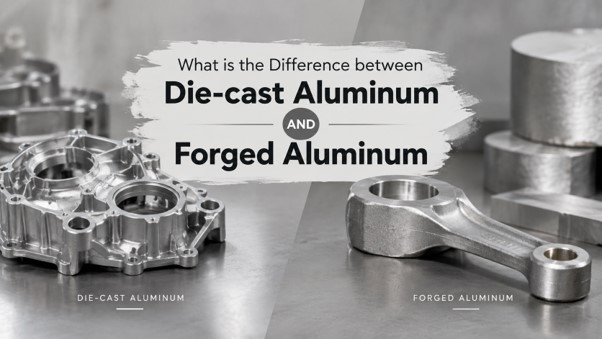
Aleaciones de aluminio habituales para forja
Las aleaciones se seleccionan en función de su resistencia, tenacidad y capacidad de tratamiento térmico. La siguiente tabla ofrece una comparación de las cuatro aleaciones de aluminio para forja más utilizadas en el estado T6, que es el más habitual.
| Aleación | Elementos clave | Resistencia a la tracción | Límite elástico | Alargamiento | Densidad | Resistencia a la corrosión | Lo mejor para |
| 6061-T6 | Mg 0,8-1,2 %, Si 0,4-0,8 % | ~310 MPa | ~275 MPa | ~12% | ~2,70 g/cm³ | Excelente | Piezas estructurales generales, ruedas, accesorios |
| 6082-T6 | Mg 0,6-1,2 %, Si 0,7-1,3 %, Mn 0,4-1,0 % | ~320 MPa | ~260 MPa | ~10% | ~2,70 g/cm³ | Muy buena | Piezas estructurales y de automoción, componentes de suspensión |
| 7075-T6 | Zn 5,1-6,1 %, Mg 2,1-2,9 %, Cu 1,2-2,0 % | ~570 MPa | ~500 MPa | ~11% | ~2,81 g/cm³ | Feria | Sector aeroespacial, automovilismo, componentes sometidos a grandes esfuerzos |
| 2014-T6 / 2024-T4 | Cu 3.9-5.0% (Mg, Mn, Si in smaller amounts) | ~480 MPa (2014-T6) / ~470 MPa (2024-T4) | ~415 MPa / ~325 MPa | ~13% / ~20% | ~2.80 g/cm³ | Poor (needs protective coating) | Aircraft structures, heavy-duty load-bearing parts |
Comparación detallada: explicación de las diferencias clave
Let’s explain the differences in a more detailed way.
1. Proceso de fabricación
The most notable difference is the way the metal is formed. Die casting is a process that utilizes liquid metal, which flows easily into the complicated cavity. Forging usually applies to solid metal that is under pressure.
Think of the ways it is like cooking. Die casting is similar to pouring batter into a mold. Forging is similar to kneading and pushing dough out of shape. The second involves building up its internal structure.
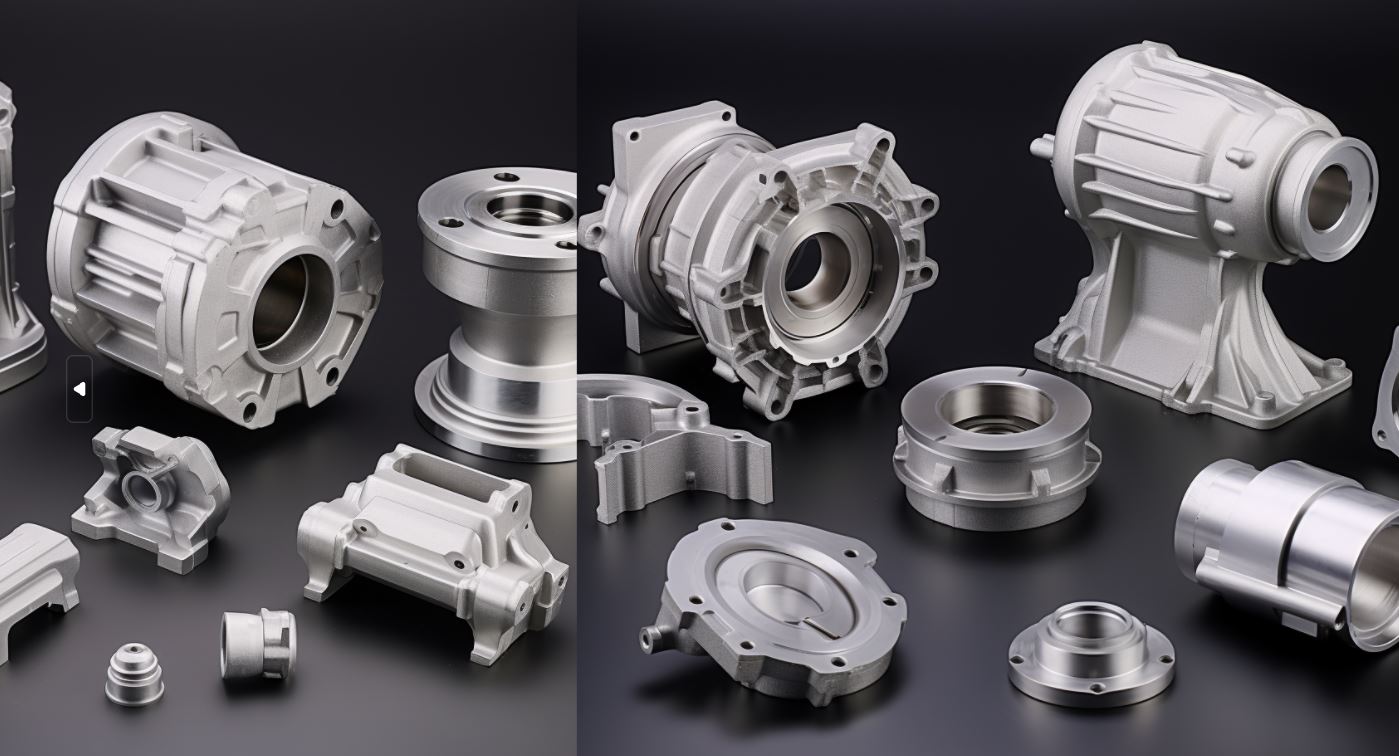
2. Resistencia y propiedades mecánicas
In practical applications, forged aluminum proves superior, especially when subjected to repeated or extreme stress.
Moreover, metal compression occurs, and internal voids are eliminated. After that, the grain flow is adapted around the metal part contours. This increases tensile strength, yield strength, and impact toughness. Also affects the fatigue life of the metal part.
Die-cast aluminium can demonstrate a decent tensile strength on paper too. The tensile property of A380 could be between those of some wrought alloys. However, the elongation (ductility) of the die-cast parts is generally low, and they are more brittle. Internal porosity may also form areas of vulnerability, causing cracks to form in the material due to cyclic loading.
3. Estructura interna y porosidad
Among the many concerns in die casting, one of the most important is porosity. High-velocity pressure injection of molten aluminium can result in trapping of air and gases. The small gaps can also occur as the metal cools and contracts.
In decorative components, these pores are inconsequential, but in pressure-bearing or load-bearing components they could be a serious problem. These include vacuum-assisted die casting, squeeze casting and optimized gating, which all minimise the amount of porosity but seldom produce a completely porosity-free cast.
Forged aluminum has a dense, void-free structure, since the process compresses the metal rather than pouring it.
4. Flexibilidad y complejidad del diseño
This is where die casting excels. Die casting can generate:
- Thin walls
- Ribs and bosses
- Fine details and text
- Internal cavities that are complicated (cores)
- Low machining load components (near-net-shape parts).
Forging is more limited. The metal must be capable of plastic flow under pressure, making very fine detail, deep cavities, and thin sections more difficult to create. Forged parts are typically simpler and cut into various shapes.
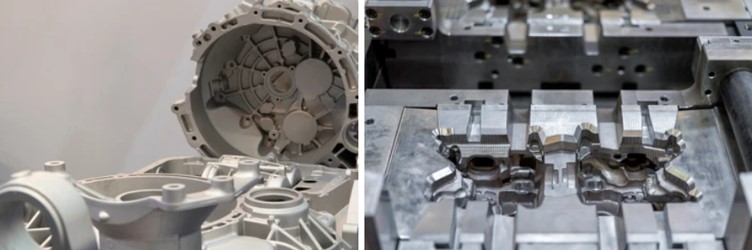
5. Comparación de costes
The production volume greatly influences the cost. For mass-produced, non-critical parts, die casting is nearly always the less-costly process. The increased reliability often outweighs the extra expense in high-performance and safety-critical parts.
6. Acabado superficial y aspecto
Most die cast parts are produced with a smooth, fine finish which is ideal for painting, powder coating, plating, or anodizing.
Forged parts are typically given more of a handcrafted feel once they’re made and will look great after the machining and finishing operations. Forged aluminum is also more likely to undergo uniform anodizing, so it is used for high-quality cosmetics like bike parts and wheels.
7. Peso
They both have aluminium materials and hence different densities. The variance in weight typically relates to design. Forged parts are also lighter for the same strength, as the engineer can use less material to obtain the same strength properties. The die casting process, then, can produce very thin wall thicknesses, and this weight saving is especially useful in the correct design.
8. Tratamiento térmico y posprocesamiento
Aluminum and its alloys, like 6061 and 7075, are very sensitive to heat treatment, increasing strength and hardness (T6e, for example).
Gaseous elements will be released when standard high-pressure die-cast parts are conventionally heat-treated at high temperatures, for which this is not suitable. Properties can be enhanced via specialized processes like vacuum die casting, low-pressure casting, and certain T5 or T7 treatments.
Aplicaciones: dónde se utiliza cada tipo
Die Cast Aluminum in General Use Applications
- Industrial: Transmission housings, engine blocks, brackets, and more and more large structural castings
- Tape and banding: Packing tape or duct tape
- Industrial products: Industrial bottles, cookware, appliance parts
- Electronic / Electrical: Antenna housings and enclosures
- Smuggling: Locked valve or lock box body, gearbox cover for smuggling locks, Engine breather, Jack port breaker.
Aplicaciones habituales del aluminio forjado
They are widely used in;
- Fabricación: Aircraft components and structural frames
- Automoción: Forged wheels, suspension arms, connecting rods, pistons
- Motorcycle / Bicycle: High-quality accessories for wheels, crank, and handlebar
- Marine and defense: Load-bearing fittings and firearm components
- Equipamiento industrial: High-pressure hydraulic fittings, heavy-duty tools
Tabla resumen de la solicitud
The following table gives a brief description of the difference between die-cast aluminum and forged aluminum;
| Industria | Die-Cast Aluminum Examples | Forged Aluminum Examples |
| Automoción | Gearbox cases, engine covers | Wheels, control arms, pistons |
| Aeroespacial | Non-structural housings | Landing gear, structural fittings |
| Electrónica | Enclosures, heat sinks | Premium device frames (machined) |
| Cycling / Motorsport | Basic brackets | Cranks, wheels, stems |
| Industrial | Pump and valve housings | High-stress fittings and tooling |
Llantas de aluminio fundido frente a forjadas: un ejemplo muy común
One of the most searched comparisons involves wheels.
- Cast aluminum wheels (including die-cast and gravity or low-pressure cast) are affordable, available in countless designs, and fine for everyday driving.
- Forged aluminum wheels are lighter for a given strength, tougher under impact, and preferred in motorsport and performance driving. They are much more expensive.
Note that most of the wheels sold as cast are also low-pressure and gravity cast, and not high-pressure die cast… safety-critical wheels require lower porosity. This still, however, shows the trade-off between costs and benefits.
¿Cómo elegir: aluminio fundido a presión o forjado?
Here are some questions to consider when choosing the process that fits your project.
Elige aluminio fundido a presión si:
- You need high volumes at a low per-part cost
- The part has a complex shape, thin walls, or fine detail
- The part is a housing, cover, or enclosure with moderate mechanical loads
- You need a smooth surface finish with minimal machining.
- Most of the time, speed and cost are more important than maximum strength.
Aluminio forjado si:
- The part must withstand high stress, impact, or fatigue
- Safety and reliability are paramount
- The strength-to-weight ratio must be superb.
- Production quantities are light to medium.
- You can pay more for greater performance
Aluminio fundido a presión frente a aluminio forjado: tabla de comparación rápida
Let’s get a quick comparison of features of both die-cast and forged aluminum;
| Característica | Aluminio fundido a presión | Forged Aluminum |
| Starting material | Molten aluminum alloy | Solid aluminum billet |
| Forming method | Liquid metal injected into a die | Solid metal compressed under force |
| Internal structure | Random grain, possible porosity | Refined, directional grain flow |
| Fuerza | Moderado | High to very high |
| Fatigue resistance | Baja | Excelente |
| Ductilidad | Bajo | Bien |
| Complejidad del diseño | Excellent for intricate shapes | Limited to simpler geometries |
| Wall thickness | Very thin walls possible | Thicker sections typical |
| Acabado superficial | Smooth as-cast | Needs machining/finishing |
| Tooling cost | Alta | Moderate to high |
| Per-part cost (high volume) | Bajo | Más alto |
| Production speed | Very fast | Más lento |
| Typical use | Housings, brackets, covers | Structural, load-bearing, safety parts |
Preguntas más frecuentes (FAQ)
1. ¿Es el aluminio forjado más resistente que el aluminio fundido a presión?
Yes, in most practical applications. Because of its finer grain structure and lack of porosity, forged aluminum exhibits superior yield strength, ductility, impact strength, and fatigue strength.
2. ¿Es más barato comprar aluminio fundido a presión o forjado?
At larger production runs, die-cast aluminum is often less expensive per component because it uses fast cycle times and near-net-shape parts. Forging costs more per piece, but can be cheaper for critical, low-volume components.
3. ¿Se puede someter a tratamiento térmico el aluminio fundido a presión?
Standard high-pressure die-cast parts are not suitable for conventional solution heat treating due to the presence of trapped gas in the parts. Some alloys can be heat-treated, and vacuum die casting can be used.
4. ¿Es el aluminio forjado más ligero que el aluminio fundido a presión?
The density is the same, but forged parts may be lighter as they can often be designed to be stronger with less material. Thin walls are another way that die casting can help to reduce weight.
5. ¿Cómo puedo saber si una pieza es de fundición a presión o forjada?
Parts that have been die-cast may exhibit parting lines, ejector pin marks, gate marks, and a very fine, smooth surface. Forged pieces almost always feature trimming flash lines and a more consistent feel. The manufacturer’s data or lab testing is typically required for reliable identification.
6. ¿Cuál es mejor para las piezas de automóvil?
It varies by component. The difference between a suit of Die casting and one of Forging is that the former is used for housings and non-critical components, and the latter for wheels, suspension arms, pistons, and other high-impact parts.
7. ¿Se oxida el aluminio fundido a presión?
Aluminium does not rust like iron; it has a protective oxide layer. In a hostile environment, coatings or painting can be used to avoid corroper; there is a possibility to corrode even in mild environment.
Conclusión
The key difference between die-cast aluminum and forged aluminum is how these materials are created, which affects all other aspects of the product. Die casting injects molten aluminum into a mold, which makes it ideal for complex, thin-walled, high-volume parts at low unit cost. Forging compresses heated solid aluminum, which gives superior strength, toughness, and fatigue resistance for demanding, safety-critical applications.
Neither process consistently performs better. The right selection depends on the performance requirements, part geometry, production volume, and cost. Die casting is used for cost-effective mass production of housings or covers. For structural load-bearing elements that can’t fail, use forged. If in doubt, talk to a manufacturing partner early in the design phase; minor design changes can transform a part into a more economical process.
0 comentarios